Designing the Operating System
for India's Insurance Gap
A systems-level solution to India's 75% life insurance exclusion — built on behavioral economics, India Stack, and 12 million kirana stores.
Product Demo — Bharat Suraksha OS · Round 1 Submission
India's insurance gap isn't a pricing problem.
It's a behavioral and trust problem wearing a price tag. Even where premiums are affordable, systemic friction keeps 75% of Indians uninsured. The crisis is accelerating: penetration fell from 4.2% (2021) to 2.8% (2024) despite GDP growth.
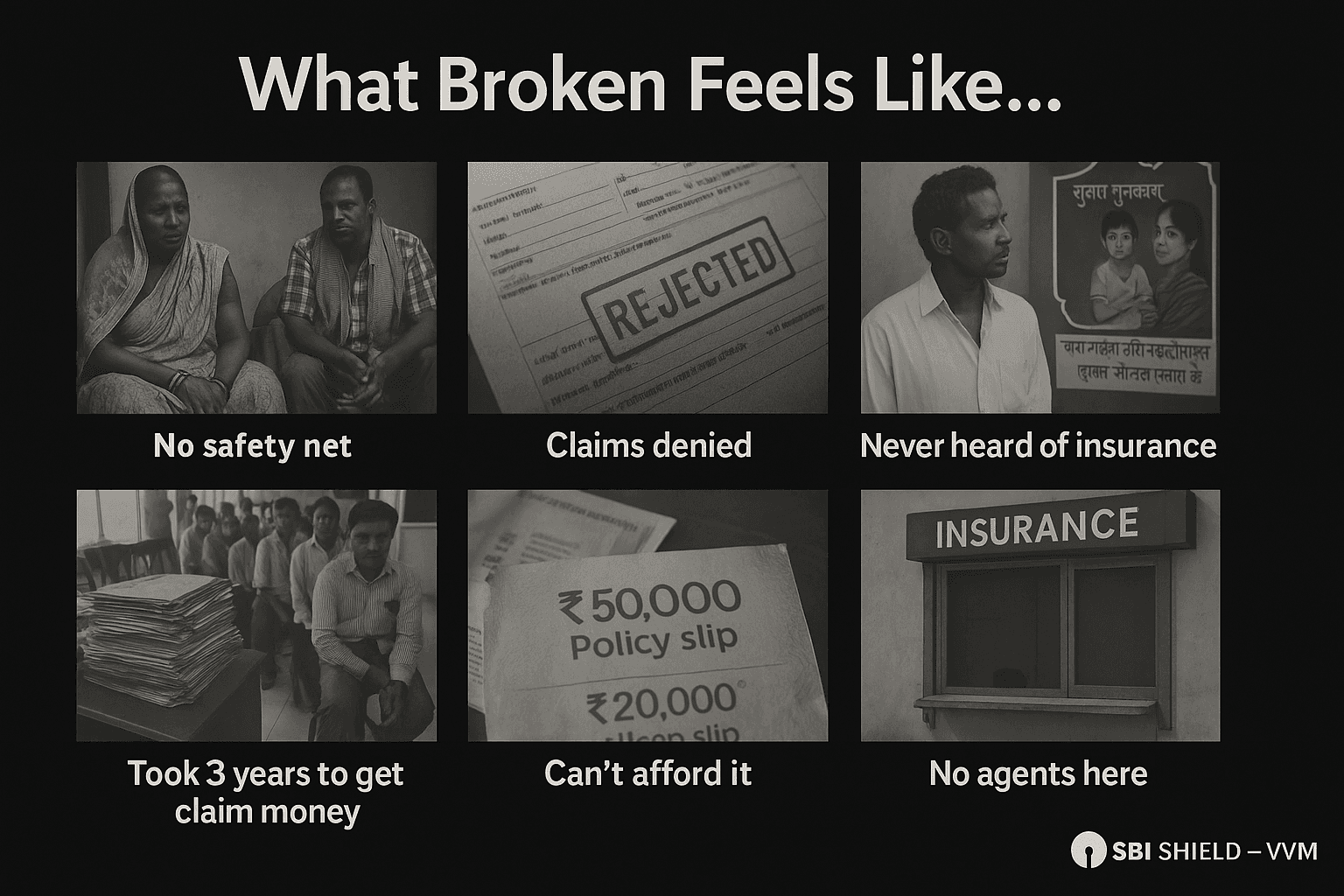
What Broken Feels Like — real stories from the uninsured
Loss Aversion
67% of Indians view insurance as savings, not protection (Dvara Research 2024). Premiums feel like money lost.
No Social Proof
90%+ of sales through agents. Community decisions dominate. Zero peer adoption = zero adoption.
Geographic Exclusion
640,000 villages. 1,011 SBI Life branches. 500M internal migrants excluded (UNCDF 2023).
Complexity Wall
50% of policies lapse before maturity. 88% of all complaints: claim rejections on technical grounds.
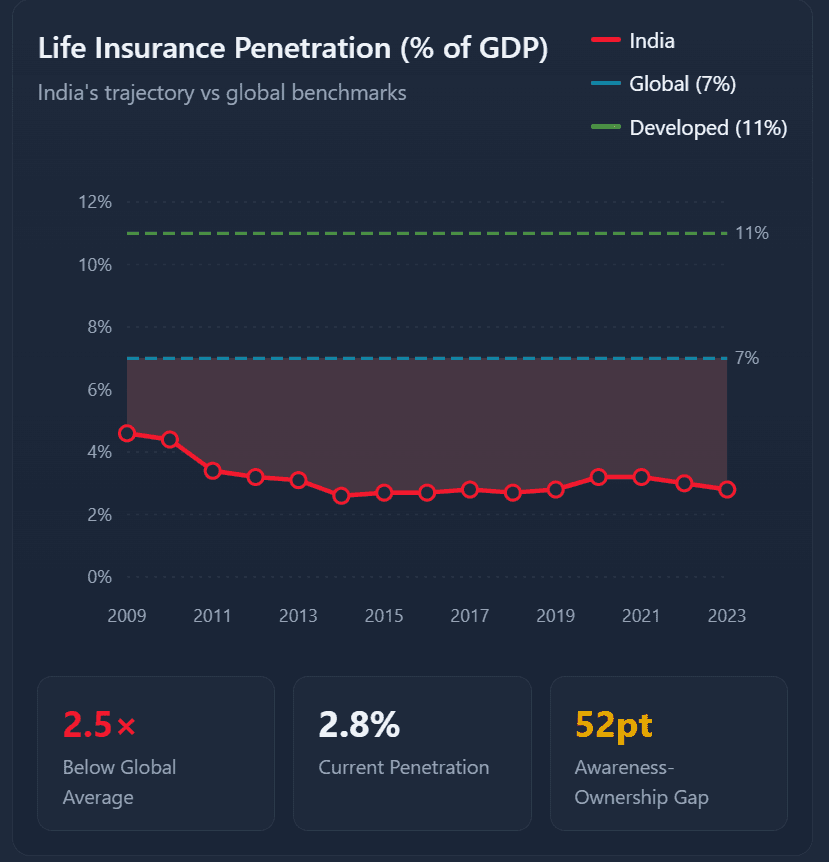
India vs Global — 2.5× below average
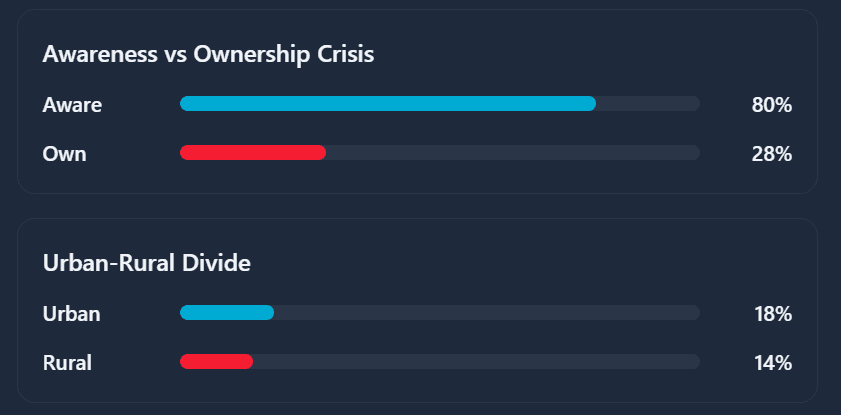
Awareness vs Ownership — the 52pt gap
The insight that changed everything: UPI succeeded not by making payments cheaper — but by making them invisible, social, and trusted. Life insurance needs the same OS-level reinvention.
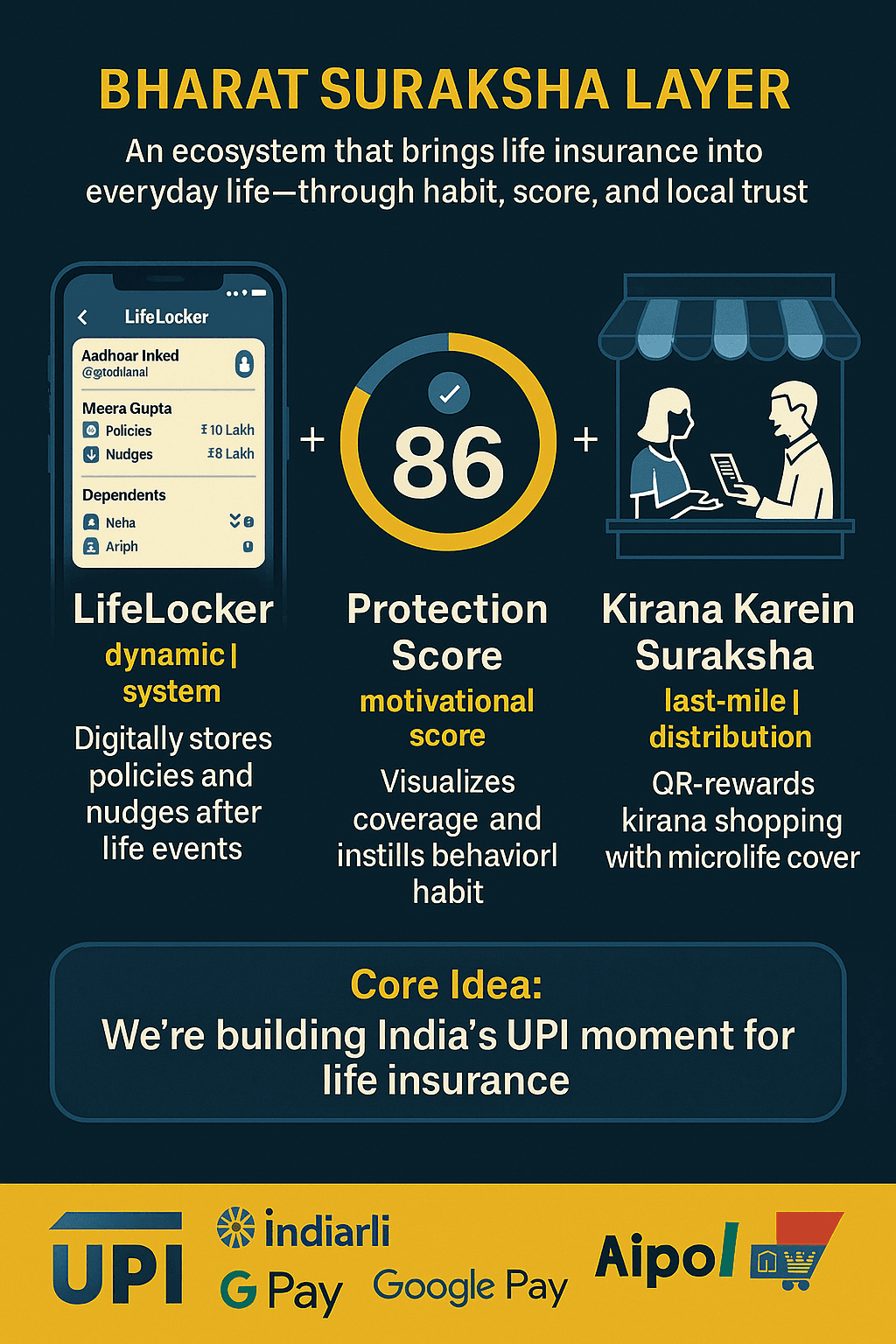
Three layers. One operating system.
Not another insurance product. A new infrastructure layer — the way UPI was for payments — that makes coverage the default, not the exception.
Universal insurance identity on Aadhaar + DigiLocker + ABHA. One ID, all policies, all providers.
0–850 composite score rewarding healthy habits, timely payments, referrals → premium discounts. Insurance as progress.
12M kirana stores as micro-agents. Voice bots in 11 languages. QR enrollment. Trusted, embedded, frictionless.
Universal insurance identity on Aadhaar + DigiLocker + ABHA. One ID, all policies, all providers.
0–850 composite score rewarding healthy habits, timely payments, referrals → premium discounts. Insurance as progress.
12M kirana stores as micro-agents. Voice bots in 11 languages. QR enrollment. Trusted, embedded, frictionless.
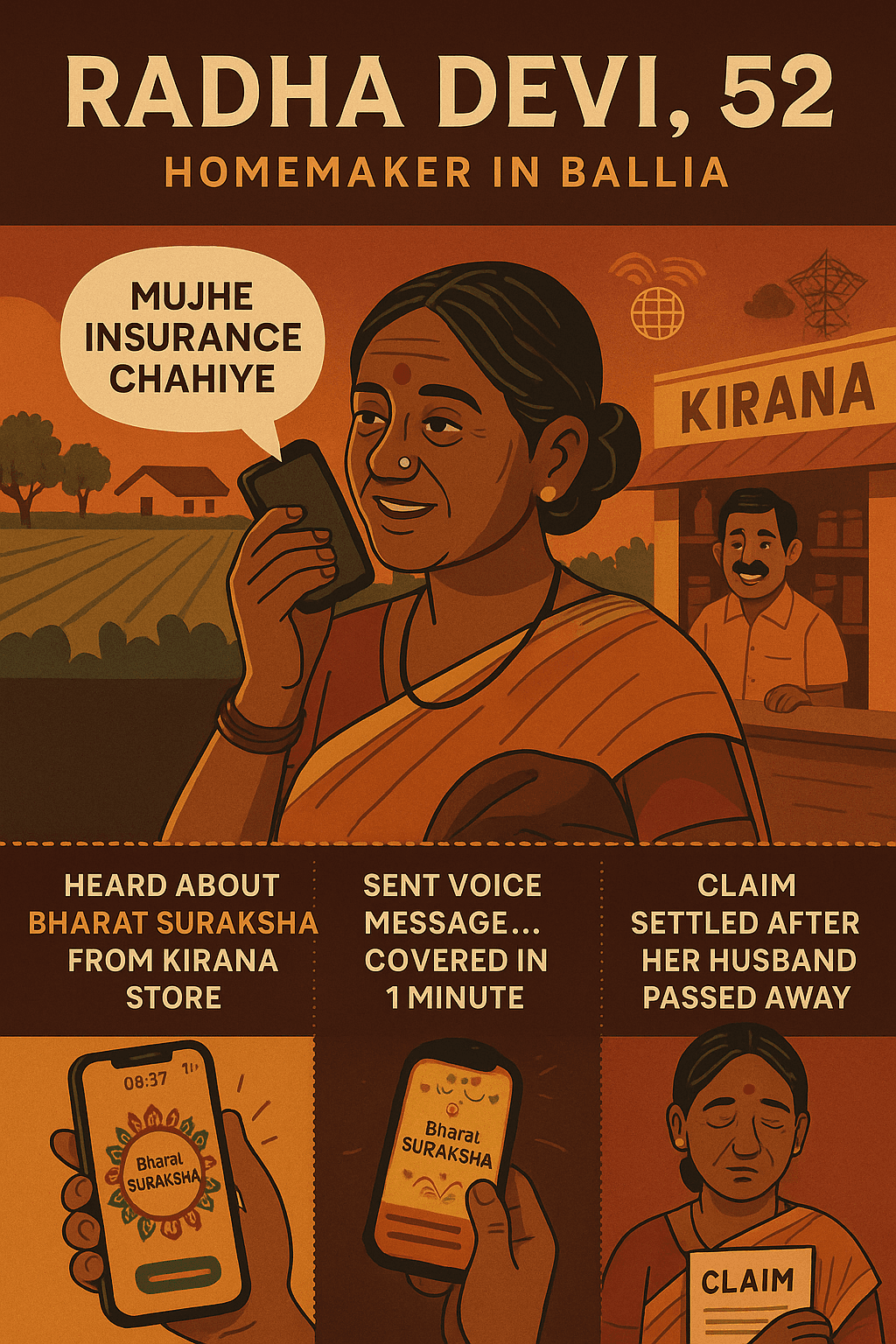
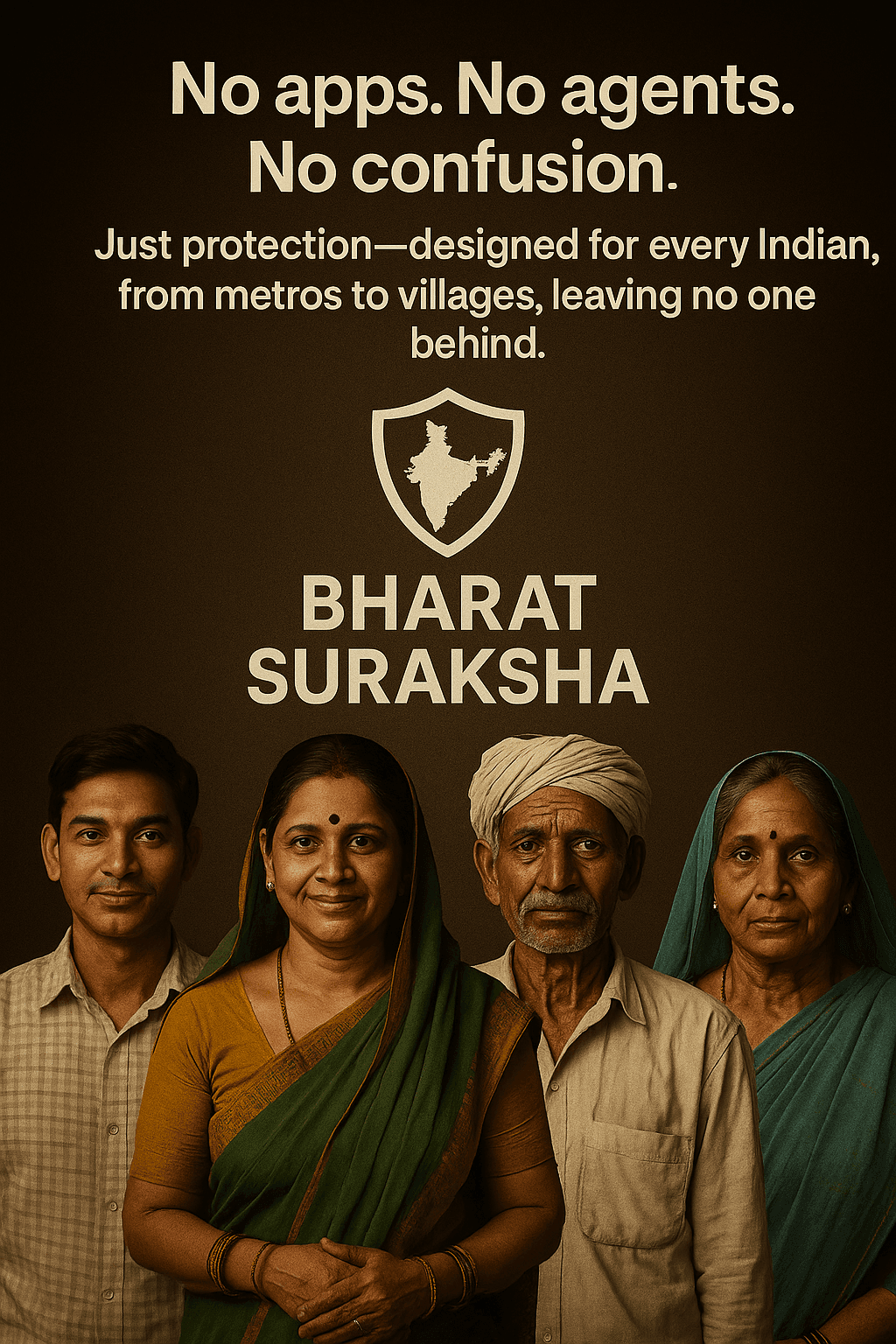
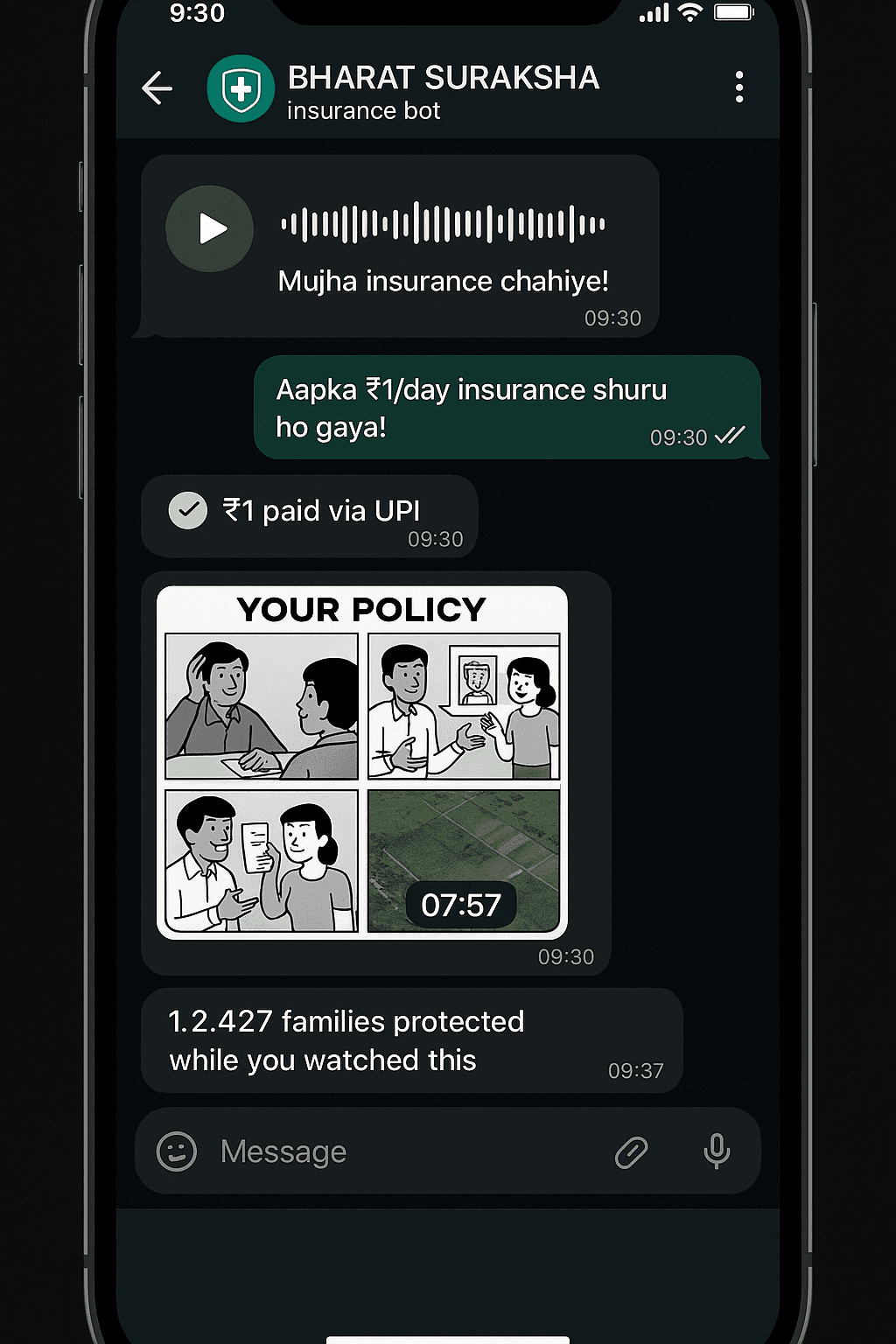
See it in action
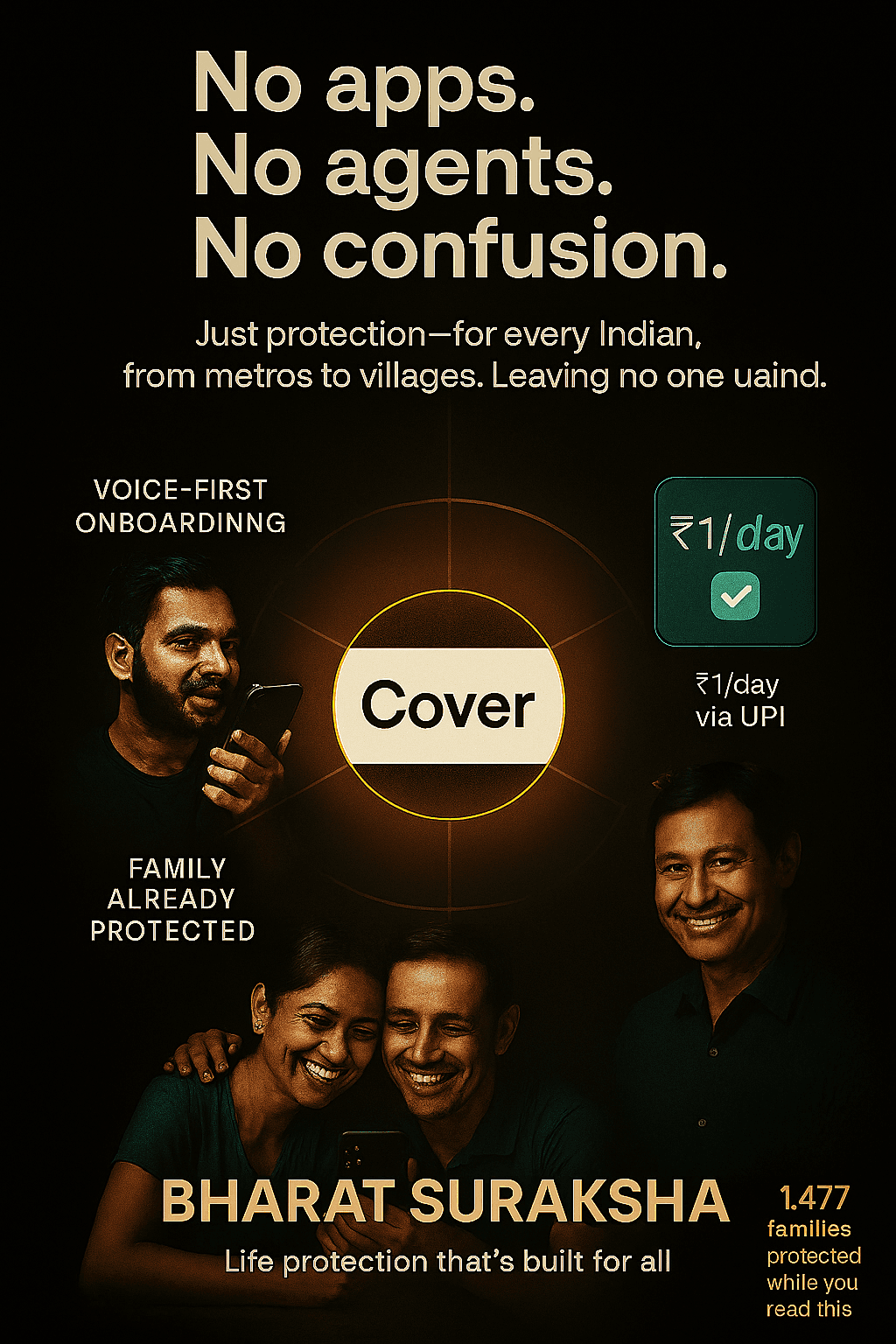
Built on India Stack. Validated on first principles.
- Bhagalpur + Tumkur pilot districts
- 20 kirana micro-agents onboarded
- Target: 5,000 policies, ₹10/day entry
- IRDAI Sandbox clearance
- 10 districts · 200 kiranas
- Voice bot in 6 regional languages
- Protection Score live
- Target: 100K policies
- All 28 states · 12M kiranas
- Voice-first enrollment in 11 languages
- Multi-record sync via DigiLocker
- Target: 200M lives covered
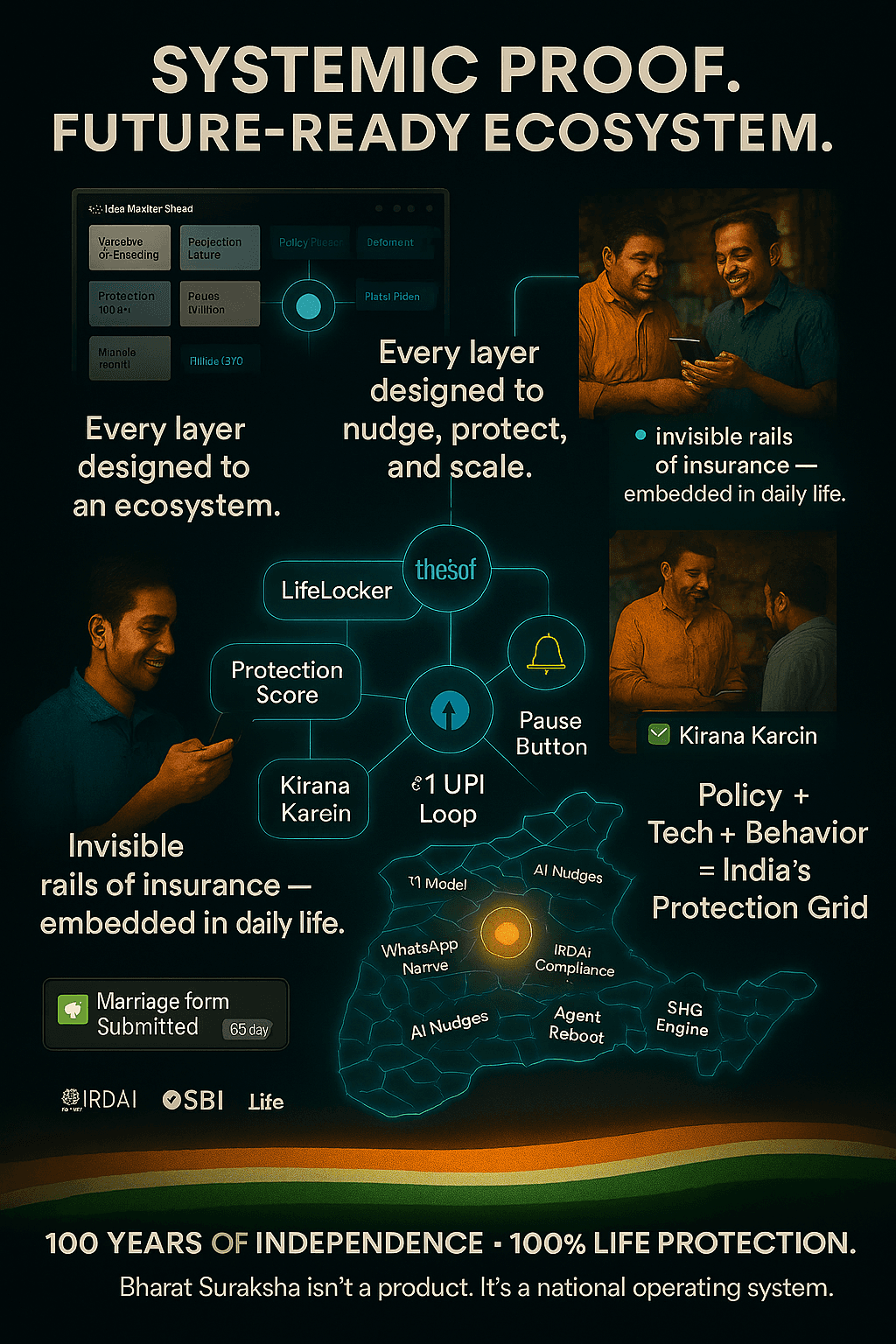
Systemic Blueprint — Full Ecosystem Mesh
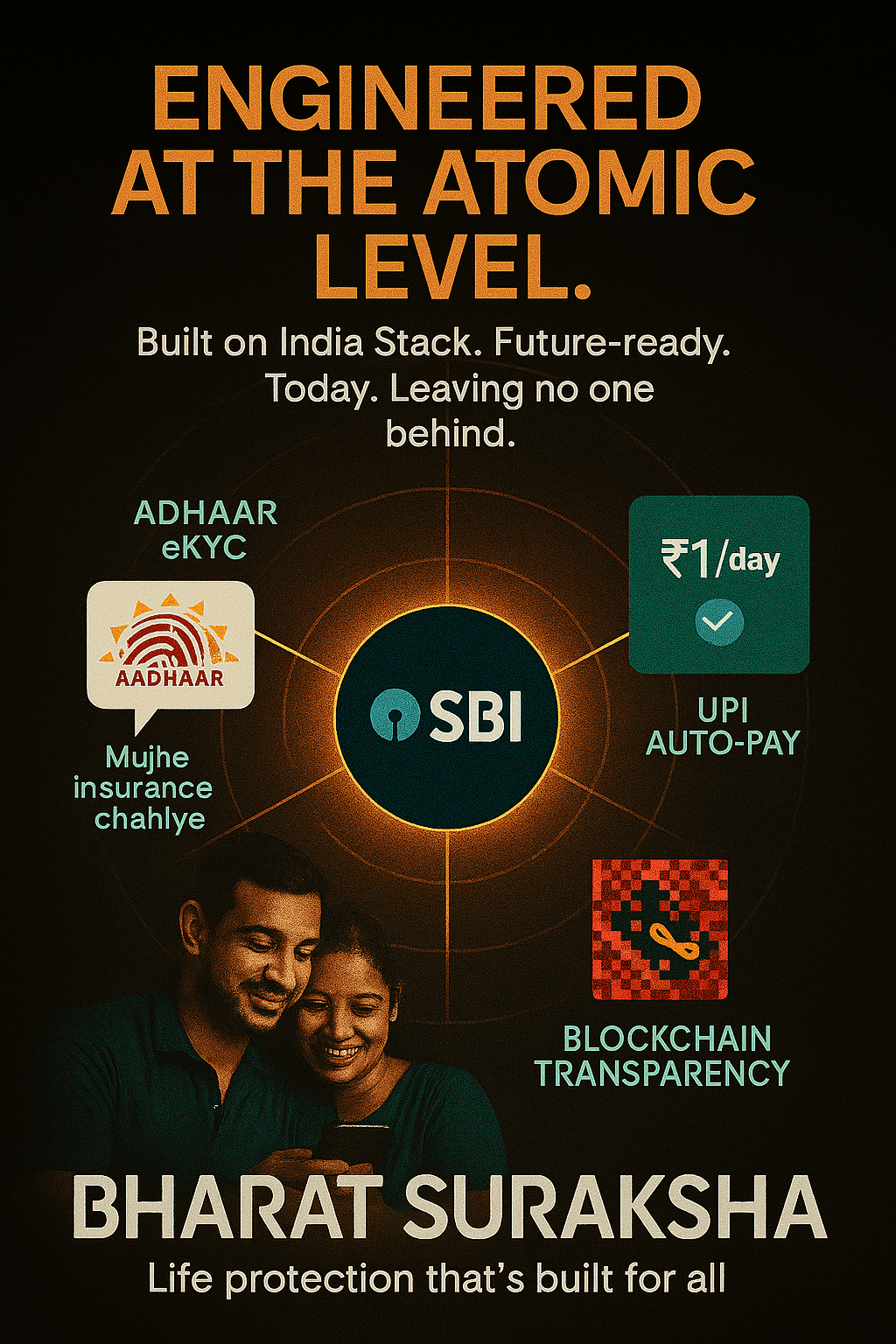
Backend Architecture
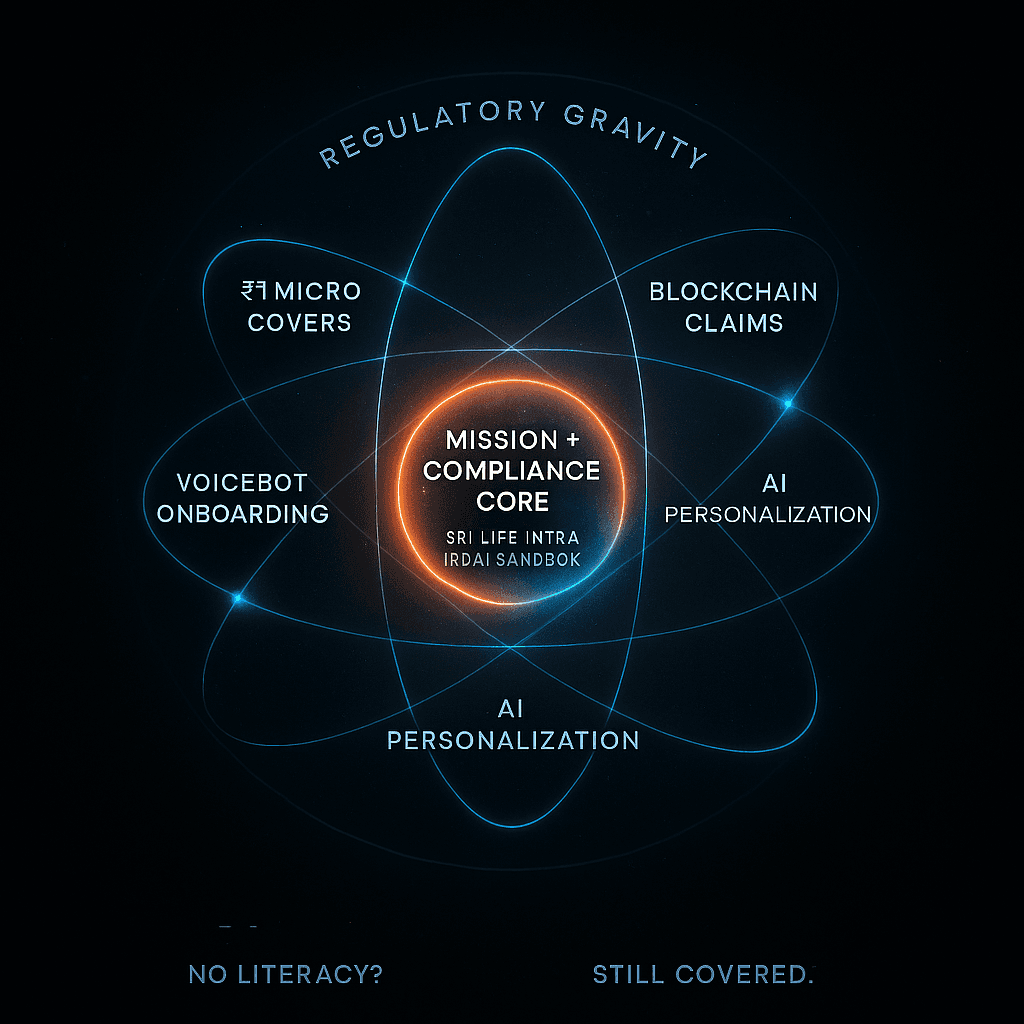
Atomic Component Model
One kirana. One city. One India.
The domino effect is the GTM thesis. One trusted kirana per neighborhood → Protection Score network grows → social proof creates viral enrollment. Raju's story is India's story.
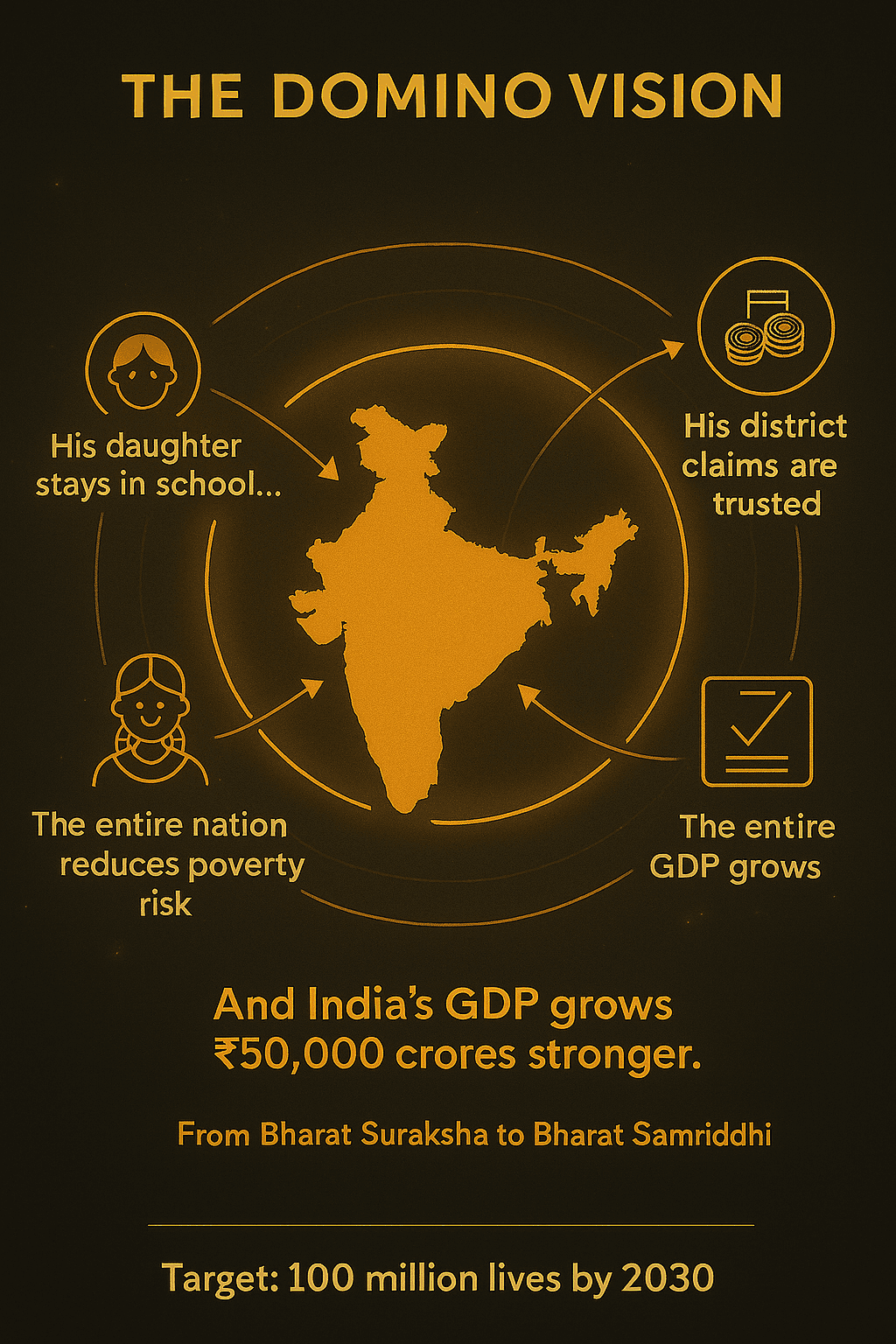
The Seed: One Kirana Micro-Agent
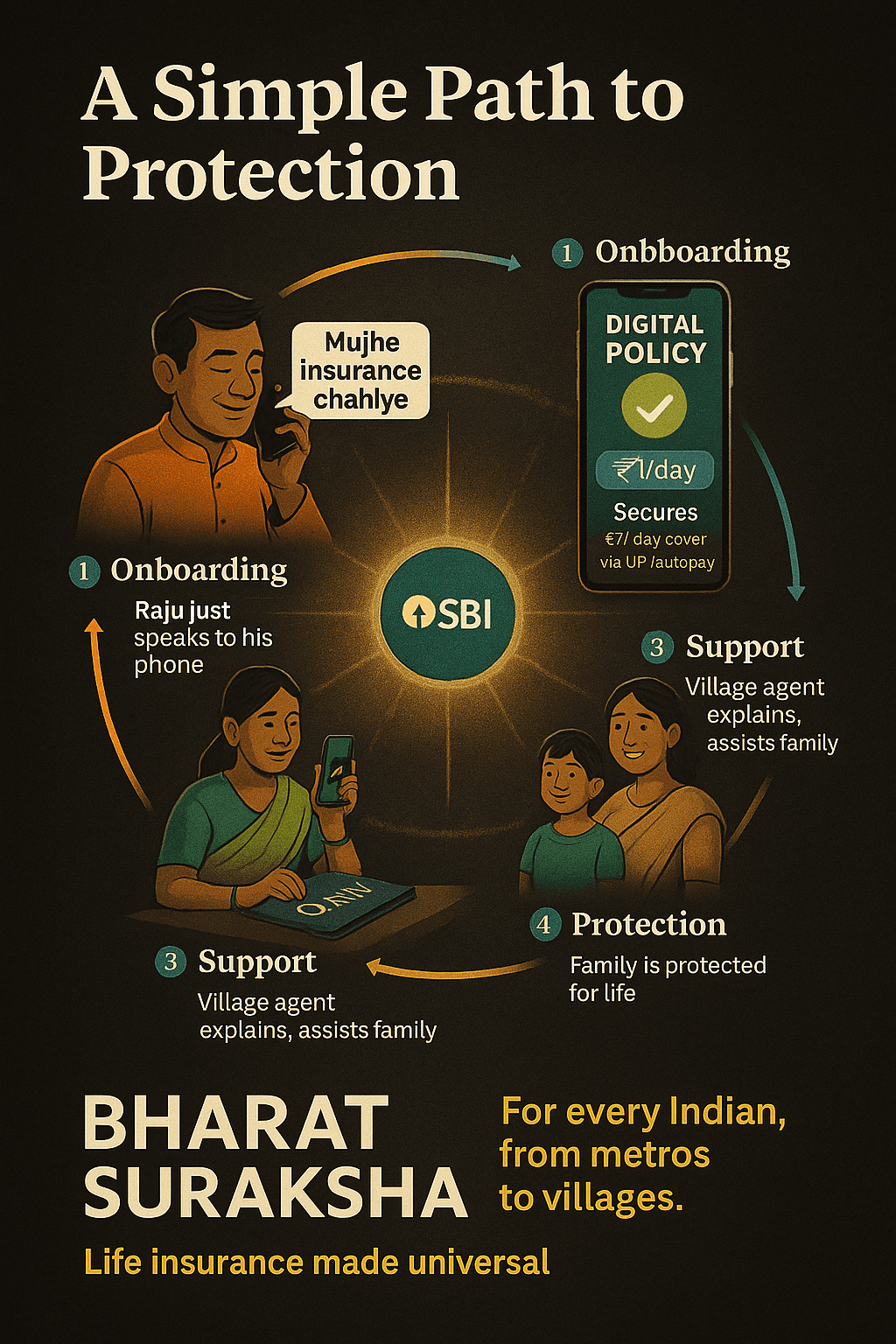
The Spread: Raju's Network Effect
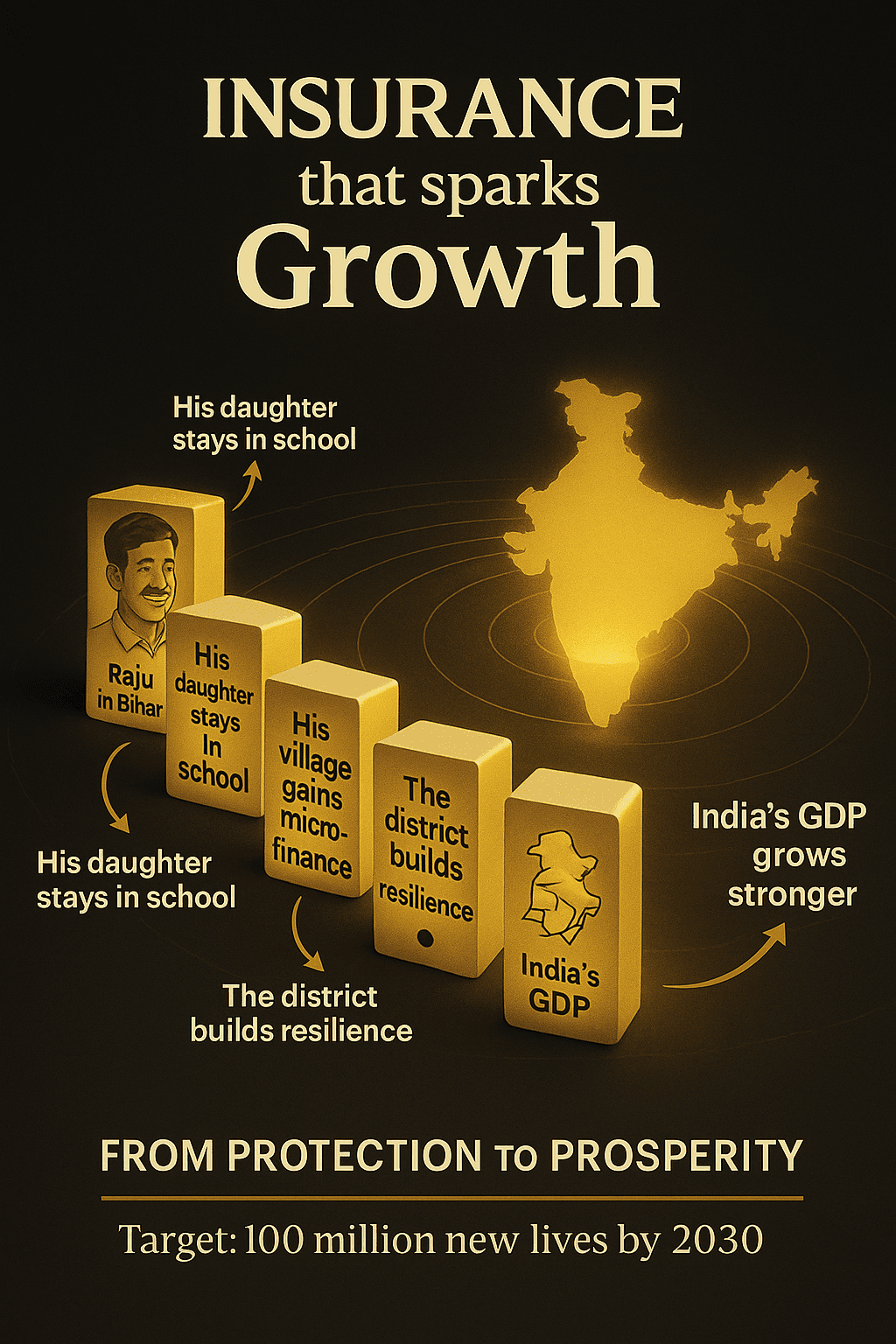
The Vision: 12M Stores, 200M Lives
Raju's Village — Where a single kirana becomes the neighborhood's safety net
The Cascade — How one enrolled family triggers seven more
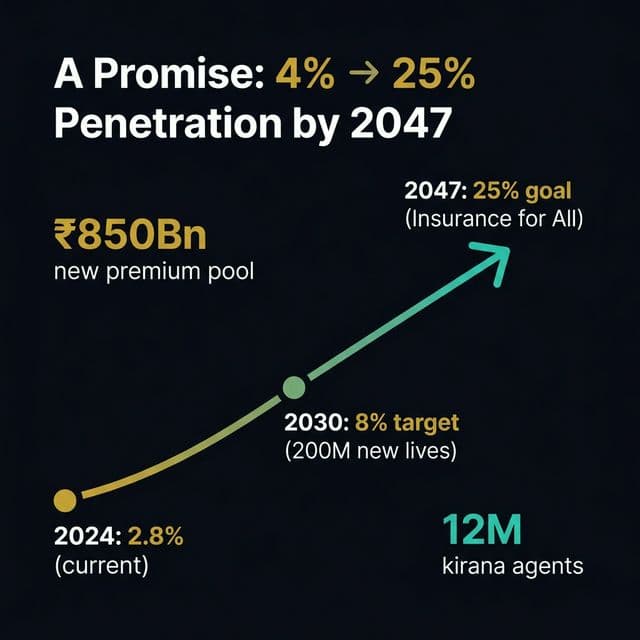
The Promise: 4% → 25% Penetration by 2047
How we got here
SBI Life's DIVE Framework structured our 6-week sprint from raw problem space to a competition-ready submission.
Field research + global benchmarks (M-PESA, WeChat Health, Colombia). Mapped invisible behavioral barriers from Dvara Research 2024.
30+ ideas → one OS thesis. Rejected product-first. Anchored on infrastructure + behavioral design as the compounding unlock.
India Stack feasibility. IRDAI Sandbox check. Unit economics: ₹10/day entry premium, CAC via kiranas ~₹120, ARPU ₹365/yr.
UPI-moment narrative. Demo video. 8-segment pitch. Packaged for non-technical evaluators without losing rigour.
The business math behind the vision.
This section was the postmortem's biggest callout. Here's the back-of-envelope that should have been in the pitch.
| Metric | Value |
|---|---|
| Entry Premium | ₹10/day (₹3,650/yr) |
| Target ARPU | ₹365/yr (Tier 4) → ₹18,000/yr (Tier 1) |
| CAC via Kirana | ~₹80–120 per activation |
| CAC via SHG | ~₹40–60 per activation |
| Expected Claim Ratio | 12–18% (micro-term) |
| Lapse Rate Reduction | ~30% with nudge system |
| Month-1 Retention | Target 85%+ |
| Reinsurance Path | Treaty reinsurance from Year 1 |
| Break-even (pilot) | Month 14 at 50K policies |
Average CAC via kirana network
Path to break-even on 50K-policy pilot
90-Day Pilot Model
Bhagalpur (Bihar) + Tumkur (Karnataka)
Tier-3 city, high kirana density, SBI branch presence
- Week 1–2: Onboard 20 kirana micro-agents per district
- Week 3–8: QR enrollment + WhatsApp bot activation. Target: 5,000 policies
- Week 9–12: First claim cases processed. Target: TAT < 10 min
- • Policy activations per 1,000 outreach ≥ 8%
- • Median claim TAT < 10 minutes
- • Month-2 retention rate ≥ 78%
- • NPS among kirana agents ≥ 7/10
The compliance path — mapped, not assumed.
The postmortem flagged this as a critical gap. Every element of Bharat Suraksha OS has a regulatory path. Here it is, explicitly.
| Component | Regulatory Path | Status |
|---|---|---|
| Kirana as micro-agent | PoSP (Point of Sales Person) license via IRDAI 2015/2024 guidelines | ✅ Current rails |
| e-KYC / digital onboarding | IRDAI VBIP (Video-based ID) + Aadhaar OTP | ✅ Current rails |
| UPI AutoPay for premiums | NPCI AutoPay mandate (e-NACH) | ✅ Current rails |
| LifeLocker identity layer | DigiLocker + ABHA API (NHA) | ✅ Current rails |
| Protection Score (behavioral data) | Account Aggregator framework (RBI AA) | 🔶 Partner PoC |
| Micro-term product design | IRDAI Sandbox (Regulatory Sandbox 2019) | 🔶 Partner PoC |
| WhatsApp policy issuance | IRDAI Insurance Repository integration | 🔶 Partner PoC |
| Blockchain policy ledger | Exploratory — no active IRDAI ruling | 🔲 Future module |
| Satellite-based claim auto-trigger | ISRO NDVI partnership — no IRDAI path yet | 🔲 Future module |
240,000+ SBI agents become guardians, not gatekeepers — they train kiranas, audit compliance, and handle escalations. 1,110 SBI branches map to pilot geographies. SBI YONO / UPI rails handle all payment flows on day one.
We built it. We stress-tested it too.
Adverse Selection Risk
Low-income micro-term attracts disproportionately high-risk claimants.
Protection Score tiers restrict entry premium to healthy baseline behaviors. Reinsurance treaty from Month 1. IRDAI-mandated claim ratio monitoring.
Kirana Agent Fraud
Kiranas enroll ghost policyholders for commission.
Aadhaar biometric at enrollment. DigiLocker verification. Commission held for 60 days pending first premium payment. Anomaly flagging via ML.
Regulatory Non-Compliance
PoSP licensing complexity slows kirana onboarding.
SBI Life acts as master PoSP license holder. Kiranas operate as sub-agents under existing IRDAI framework. Legal opinion obtained.
Low Digital Literacy
Target demographic can't use WhatsApp or QR-based enrollment.
Kirana handles enrollment on behalf of customer (assisted model). Voice bot in 11 languages. SMS fallback. No smartphone required for policyholder.
Premium Lapse / Churn
50% industry lapse rate replicates in our model.
Protection Score streak breaks create loss-aversion in our favor. Premium Giveback reframes lapse as penalty. Nudge sequence: D+3, D+7, D+14 via WhatsApp.
Data Privacy / DPDP Act
Behavioral data collection violates India's Digital Personal Data Protection Act 2023.
Explicit consent at enrollment. Account Aggregator framework for data flows. No data sold to third parties. Grievance officer designated per IRDAI norms.
What I carry forward
The frame is the product
"Family Love Fund" vs. "insurance policy." Language design is product design.
Distribution beats product
India's failures are distribution failures. The kirana insight came from "who does India trust?" not "who sells insurance well?"
Defaults do the work
Enrollment should require opting out. Behavioral architecture over features.
new lives by 2030
new premium pool
penetration path to 2047
See the full research process
Frameworks, benchmarks, DIVE analysis, ideation database, postmortem — documented in Notion.
Open Research Workspace →Bharat Suraksha OS · SBI Life IdeationX 2.0 · Portfolio Case Study
Built with Next.js, Tailwind CSS & Framer Motion · Deployed on Vercel